


HoLEP for the treatment of prostate hyperplasia in Assuta Medical Centers
Benign prostate enlargement impairs the quality of life for many men. Assuta Medical Centers offers a surgical procedure using the HoLEP method, which is a revolution in the treatment of prostate hyperplasia.

Benign prostate enlargement is a natural condition that exists in all men. Over the years, the prostate gland, located in the pelvis, increases. From the size of a walnut, it expands so that it encloses the urethra and presses on the urinary duct. This pressure causes a weaker urine flow, and even at the end, there is still a feeling of residue. The result is an urgent need for the toilet and a slower emptying process. The most common complaint of men suffering from prostatic hyperplasia is the need to get up at night to go to the toilet. In extreme cases, a man suffers from urinary retention, which is a real emergency. In addition, benign enlargement can lead to recurrent urinary tract infections, bleeding, and the need for a catheter.
About half of men in their 60s and the vast majority of men in their 70s suffer from this problem and its associated symptoms. Possible treatments are divided into medicinal and surgical operations. The role of drugs is to suppress the growth of the prostate gland or dilate the urethra, which allows the flow to flow better. In a situation where drugs do not help, or when there are complications arising from benign enlargement, therapeutic options narrow and there is no escape from surgery.
The surgical method is determined by three main factors: prostate size, side effects, and experience of the surgeon, and can be performed using several surgical approaches.
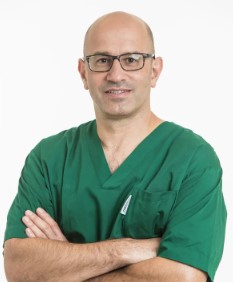
One of them has been known for about 25 years, and Dr. Gnesin is a world expert in it. This is the HoLEP method – laser removal of the prostate. In this operation, all the tissue is removed through the urethra, without the need for an incision in the abdomen.
“This is a technology that has revolutionized the world. HoLEP is currently the most accepted and recommended treatment for prostates larger than 80 cm3 by the American and European Associations of Urology,” says Dr. Gnesin. “The operation is performed under full or partial anesthesia. Since there is no abdominal incision, the operation is almost painless and does not cause the suffering that exists with open surgery. Long-term results are similar to those of open surgery, but in the short term, recovery is faster and you can return to normal activities quickly.”
How is the operation performed?
“The surgeon enters through the urethra and uses a laser to peel off the entire inner glandular part of the prostate. The laser wave allows you to exfoliate the prostate, precisely controlling the bleeding. You can imagine the surgical process as if the prostate is an orange that the surgeon peels from the inside. He works between the capsule and the glandular part and after he removes the entire glandular part, the removal is complete. All tissue with growth potential is removed and sent for pathological examination. Since the operation achieves complete removal by laser technology, significant bleeding after the operation is rare. The time spent with the catheter is less than 24 hours. Hospitalization is also short, only one day.”
What are the additional benefits of the HoLEP operation?
“The laser cauterizes the blood vessels, so there is little bleeding during the operation. The laser is superficial and does not penetrate deep into the capsule, so it does not damage the erectile nerves that are on the sides of the prostate.”
In recent years, a new technology for HoLEP operations called Moses 2.0 has emerged. It was developed by the Israeli company Lumenis, whose surgical division was acquired in 2021 by major biomedical corporation Boston Scientific.
“With this advanced technology, exfoliation of the prostate from the inside is more efficient. Changing the laser wave leads to a more effective coagulation. This allows us to further reduce the time of hospitalization of the patient, some are discharged on the day of surgery without a catheter,” emphasizes Dr. Gnesin.
“Another advantage of HoLEP is the technological possibility of simultaneously treating the prostate and kidney or bladder stones. In fact, this is a laser for endoscopic fragmentation of bladder stones or kidney stones, so there is the possibility of simultaneous treatment if the patient has both pathologies.
Every operation has risks too.
“True, but rare. Possible complications include development of a stricture or scarring in the urethra/bladder neck. There may also be bleeding or hole formation, but this is rare. The operation usually goes smoothly, lasting about an hour and a half, after which you rest at home for several days and you can return to normal activities. As with any prostate surgery, the recovery period in terms of urination is usually two or three weeks.”
Dr. Gnesin was the first to bring HoLEP surgery to Israel. This happened in 2011, and a few years later he moved to a medical center in Cleveland, USA, where he served as head of prostate and urinary tract stone surgery department. In 2019, he returned to Israel and since then has been working at the Assuta Medical Center. To date, he has performed more than 1,500 HoLEP surgeries, of which more than 650 have been performed at Assuta medical centers.
The original article in Hebrew was published by the Haaretz newspaper.